
When solar panels are installed on a roof, they become exposed to a unique set of environmental challenges. Unlike ground-mounted arrays, cleaning solar panels on roof systems involves navigating height, limited access, structural integrity, and weather exposure. For facility managers, EPC contractors, and solar maintenance professionals, this isn’t just about washing glass—it’s about protecting a significant energy asset and ensuring it delivers its promised return on investment for decades.
This comprehensive guide cuts through the noise to provide actionable, professional strategies. We’ll move beyond basic advice to explore the operational frameworks, equipment selection criteria, and safety protocols that distinguish a routine cleaning from a professional maintenance operation that boosts performance, extends asset life, and keeps teams safe.
Why “Cleaning Solar Panels on Roof” is a Critical Operational Discipline
Searching for information on cleaning solar panels on roof installations reveals a user who understands there’s more at stake than just aesthetics. This is a hybrid intent—part informational, part commercial. Users are often professionals seeking to optimize a process, reduce risk, or scale an operation. The core realization is this: dirt and debris on a rooftop solar array don’t just sit there; they actively cost money every single day by reducing energy yield.
Studies from institutions like the National Renewable Energy Laboratory (NREL) and real-world operational data consistently show that soiled panels can experience power output reductions of 15% to 25% annually, with losses spiking to 30% or more in arid, dusty, or heavily polluted environments. On a large commercial rooftop system, this can translate to tens of thousands of dollars in lost revenue each year, directly impacting the project’s financial model.
The physics is straightforward. A layer of dust, bird droppings, or pollen scatters and absorbs sunlight before it can reach the photovoltaic cells. This is the “soiling loss.” Furthermore, dirt creates uneven shading, which can lead to “hotspots”—localized areas of extreme heat that accelerate the degradation of the solar cells, potentially causing permanent damage and voiding warranties. Therefore, a structured cleaning program is not an expense; it’s a direct investment in asset performance and longevity.
Deconstructing the Challenges: What Makes Rooftop Cleaning Different?
Successfully cleaning solar panels on roof structures requires acknowledging and planning for a distinct set of hurdles not present in ground-mount scenarios.
- Height and Fall Protection: The Primary Safety Hazard
Any work at height carries inherent risk. Rooftops can be slippery, have fragile surfaces, or feature unexpected obstacles. The simple act of carrying equipment up a ladder introduces danger. Professional operations mandate strict adherence to Occupational Safety and Health Administration (OSHA) standards or local equivalents, which may require harness systems, guardrails, or detailed fall protection plans. The goal of any cleaning method should be to minimize the time personnel spend in fall-risk zones. This is where equipment with extended reach or remote operation becomes not just convenient, but a critical safety tool. - Limited Access and Weight Restrictions
Roof access may be confined to a single hatch or ladder. This limits the size and type of equipment that can be brought onto the roof. Furthermore, commercial roofs, especially older ones, have strict weight load limits. Walking on certain areas, pooling water, or using heavy machinery can compromise the roof membrane, leading to leaks and structural issues. Effective cleaning solutions must be portable, lightweight, and allow for operation from the roof’s edge or safe walking paths. - Water Management and Control
Water is essential for effective cleaning, but on a roof, it’s a potential liability. Uncontrolled water flow can seep under panels, into electrical conduits, or through seams in the roofing material, causing electrical shorts, corrosion, and interior water damage. Professional cleaning requires a controlled, low-volume water application strategy. Techniques like pressurized misting, brush-integrated water feeds, and water-recovery systems are designed to use minimal water while preventing runoff and pooling. - Risk of Panel Damage
Rooftop panels are often less accessible for close inspection. Using overly abrasive brushes, contaminated water (with minerals or sediments), or high-pressure sprays can cause micro-scratches on the anti-reflective coating. These scratches permanently reduce light transmittance and become focal points for future soiling. Professional-grade equipment uses soft, non-abrasive roller brushes and purified or softened water to clean effectively without damaging the panel’s delicate surface.
Building Your Rooftop Cleaning Strategy: Matching Method to Application
There is no one-size-fits-all solution for cleaning solar panels on roof installations. The optimal approach is dictated by the system size, roof type, frequency of cleaning, budget, and labor availability. Let’s explore the spectrum of professional methods.
Method 1: Manual Cleaning with Telescopic Water-Fed Brushes
This is the most accessible entry point for cleaning solar panels on roof systems, particularly for smaller commercial buildings, residential arrays, or portfolios with diverse, scattered sites.
How it works: Operators use poles that telescope from 4 meters (13 feet) up to 15 meters (50 feet) or more. A soft, rotating brush head is attached to the end, and a hose connects to a water source (often fed from a ground-level tank with a filtration system). The operator guides the brush across the panels from a safe position on the ground or a stable platform.
Best for: Low-rise buildings, tilted residential roofs, spot-cleaning bird droppings, and operations with low cleaning frequency. It’s also an excellent backup or supplemental tool for any maintenance team.
Professional Considerations:
Water Quality: Always use deionized (DI) or purified water. Tap water leaves mineral spots (water spots) that bake onto the panel, reducing efficiency and requiring more aggressive cleaning later.
Brush Technology: Look for composite bristles that are gentle on glass but effective at agitating dirt. Brushes with a central water jet provide a rinsing action during scrubbing.
Labor Intensity: While safer than climbing, this method is physically demanding and time-consuming for large areas. It’s ideal for cleaning up to 50 kW systems or for targeted maintenance.
Method 2: Semi-Automated Roller Brush Systems
For dedicated solar maintenance companies or facilities with large, flat commercial rooftops, semi-automated systems represent a significant leap in productivity and consistency.
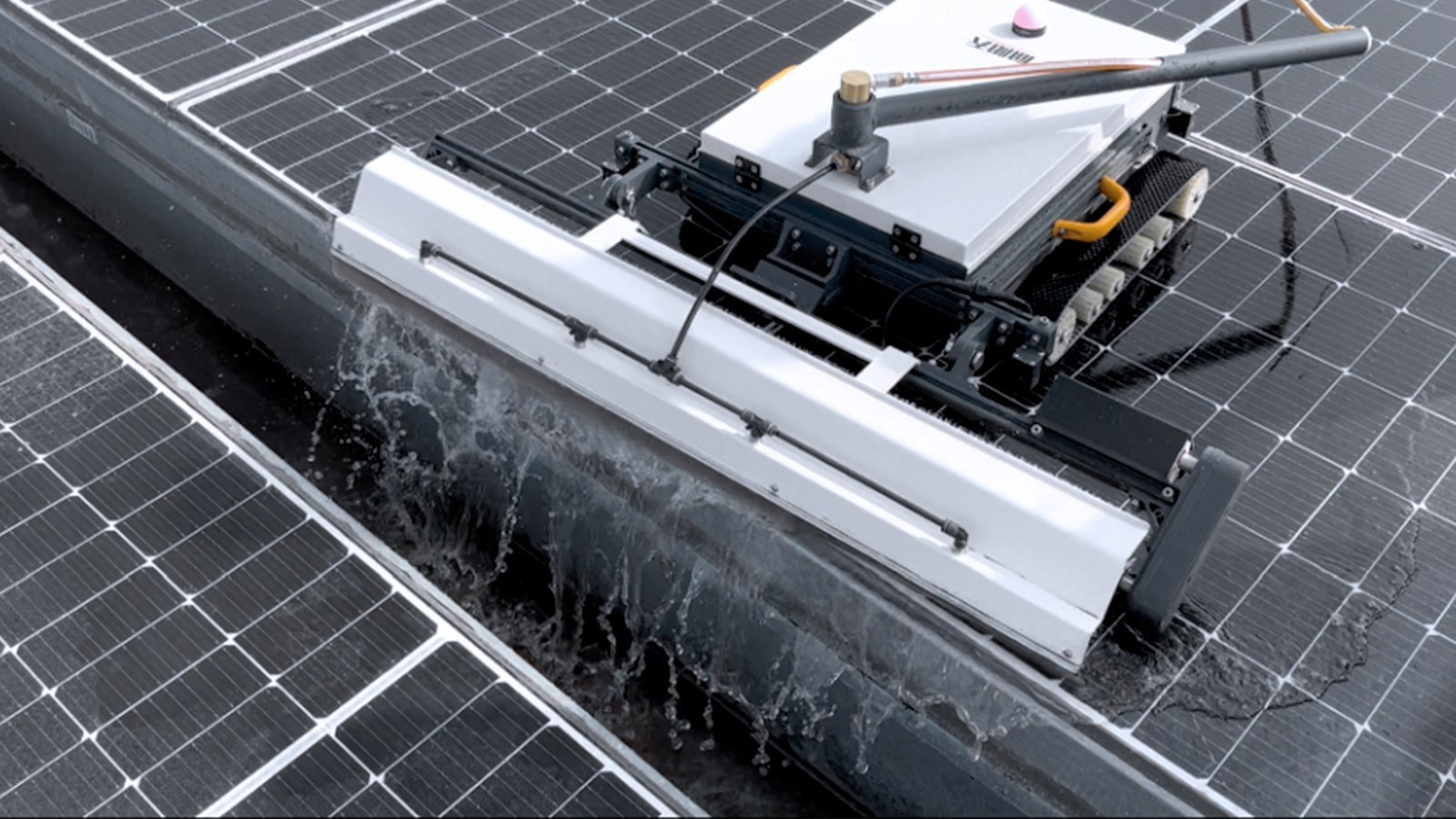
How it works: These are wheeled or track-driven units that an operator guides across the roof. They feature one or two large, motorized roller brushes (often 60-100 cm wide) that spin to scrub the panels. They integrate their own water tanks and filtration systems, and some are electrically powered via battery packs. The operator walks behind the unit, directing its path.
Best for: Large, flat commercial and industrial (C&I) rooftops, warehouse facilities, and solar carports. They are the workhorses for contracts requiring regular, scheduled cleanings.
Professional Considerations:
Throughput: A double-head system can clean over 1,000 square meters (10,000 sq ft) per hour, dramatically reducing labor costs per panel.
Cleaning Quality: The even pressure and consistent brush rotation provide a uniform clean, superior to manual methods. Many models offer adjustable brush pressure for different soiling levels.
Logistics: These units need to be transported to the roof, which may require a lift or crane for very high buildings. Their weight distribution is designed to be roof-safe.
Method 3: Remote-Controlled and Robotic Systems
This is the cutting edge for cleaning solar panels on roof systems, particularly those that are large, sloped, or present high safety risks. It represents a shift from labor-intensive work to technology-driven asset management.
How it works:
Suspended Robots: For panel arrays mounted on framing with a gap underneath, a robot can travel on rails or cables suspended between rows. It’s controlled via a wireless remote, cleaning an entire row autonomously after setup.
Crawler Robots: For pitched roofs or arrays without a sub-structure gap, lightweight tracked robots can be placed directly on the panels. They use vacuum adhesion or gentle tracks to traverse the glass surface, cleaning as they go, all controlled remotely from the ground.
Best for: Utility-scale rooftop plants, steeply tilted roofs, high-rise buildings, and sites where minimizing human roof access is a top priority for safety or insurance reasons.
Professional Considerations:
Safety Revolution: This method virtually eliminates fall risks. Operators work from the ground.
Water and Energy Efficiency: Robotic systems often use precise, low-volume misting systems and are highly energy-efficient, aligning with the sustainability goals of the solar asset itself.
Initial Investment vs. Lifetime Cost: The upfront cost is higher, but for large or complex sites, the reduction in labor, liability, and downtime provides a compelling ROI. They also enable cleaning during milder weather conditions when manual work might be unsafe.
The Proactive Maintenance Calendar: Timing Your Roof Cleaning for Maximum Impact
Cleaning shouldn’t be reactive. A professional approach follows a predictive schedule aligned with environmental cycles.
The Pre-Rainy Season Clean (The Most Important Cleaning)
Cleaning before the onset of seasonal rains is arguably the most critical service. The goal is to remove all loose dust, pollen, and organic matter. If this layer is left on, the rain turns it into a cement-like mud that bonds to the glass. This “mud-staining” is extremely difficult to remove and causes long-term soiling loss. A thorough pre-rain clean ensures that when the rain comes, it acts as a natural rinse, leaving the panels in optimal condition.
Dry Season and High-Pollution Interval Cleaning
In arid climates or areas with heavy industrial or agricultural pollution, more frequent dry cleanings or light washes may be necessary to prevent abrasive dust from scratching panels or thick layers from forming. The frequency can range from monthly to quarterly and is best determined by soiling rate sensors or regular drone inspections.
The Post-Rainy Season Inspection and Touch-Up
After the rainy season, a professional inspection will identify any remaining stubborn stains (like water line marks or mud splatter) or new debris. A targeted cleaning using appropriate, panel-safe cleaning agents can restore full performance. This is often less intensive than the pre-rain clean if the pre-rain service was done correctly.
The Economics of Professional Rooftop Solar Cleaning
Justifying the cost of a professional cleaning program requires a financial lens. Let’s build a simple model for a 500 kW commercial rooftop system.
Assumption: Average electricity rate: $0.12/kWh. Annual soiling loss without cleaning: 18%.
Lost Revenue: 500 kW * 4.5 avg sun hours/day * 365 days * 0.12/kWh * 18% loss = Approximately $17,700 per year.
Cleaning Cost: Two professional cleanings per year at a market rate of $0.015 per watt = $7,500 annually.
Net Financial Gain: $17,700 (loss avoided) – $7,500 (cleaning cost) = $10,200 annual net gain.
This doesn’t even factor in the extended panel life from preventing hotspots, the potential reduction in O&M troubleshooting, or the preserved asset value. The business case is clear.
Selecting a Partner or Equipment Supplier: The Professional’s Checklist
Whether you’re outsourcing the service or building an in-house team, due diligence is key. Look for partners or manufacturers that demonstrate the following:
Safety-First Culture: Can they provide detailed method statements and risk assessments? Is their equipment designed to mitigate height risks?
Technology and Methodology: Do they use purified water? Are their brushes non-abrasive? Can they scale their solution from a small warehouse to a vast distribution center roof?
Proven Track Record & Certifications: Ask for case studies from similar roof types. Credible manufacturers will have ISO quality certifications, electrical safety marks (CE, UL), and a history of deployment.
Focus on Water Conservation: In an era of water scarcity, the best solutions are designed to maximize cleaning power per gallon. This is both an environmental and a practical advantage.
Data-Driven Approach: The future of O&M lies in data. Can they provide pre- and post-cleaning production data analysis to quantify the performance uplift of their service?
The Future of Cleaning Solar Panels on Roof: Integration and Intelligence
The next evolution is moving from scheduled cleaning to condition-based cleaning. This involves integrating soiling sensors with the solar inverter data. When the sensors detect soiling losses exceeding a predefined economic threshold (e.g., 5%), the system automatically generates a work order for the cleaning crew or even dispatches an autonomous robot if one is on-site.
Furthermore, drone technology is revolutionizing inspection. Before a cleaning crew is even dispatched, a drone can map the entire roof, using multispectral imaging to identify the dirtiest sections (showing as cooler thermal signatures) and any existing damage. This allows for hyper-efficient, targeted cleaning operations and detailed digital reporting for asset owners.
Cleaning solar panels on roof installations has matured from a manual chore into a sophisticated discipline blending safety engineering, water chemistry, mechanical design, and data analytics. For asset owners and operators, embracing this professional approach is the surest way to guarantee that their rooftop solar investment shines at its full potential, season after season, for the life of the system. The sun provides the energy; our expertise ensures none of it goes to waste.