
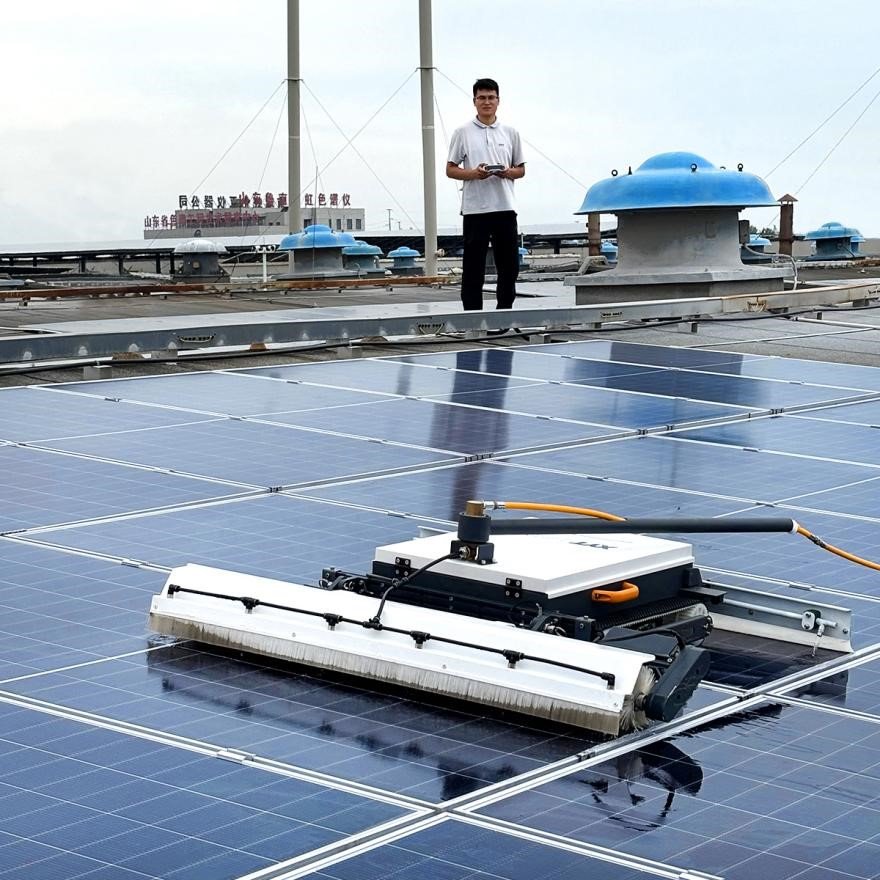
In the vast Gobi Desert of northwest China, Mr. Wang, the operations and maintenance manager for a large photovoltaic power station, recently finally found relief. In the past, after a dust storm, he would gaze upon the dust-covered photovoltaic panels and worry about how to organize efficient and safe cleaning. Traditional manual cleaning is not only inefficient and costly, but also carries significant safety risks when working on tilted panels. However, all this has fundamentally changed with the deployment of several Xiangyangtian X7 Pro remote-controlled crawler photovoltaic cleaning robots.
When the X7 Pro was first deployed on-site, its modular design immediately amazed Engineer Wang’s team. The entire robot can be easily disassembled into four modules weighing no more than 20 kilograms, allowing two workers to easily transport and quickly assemble it, greatly reducing the difficulty of relocation operations within the massive power plant. After starting the equipment, the operators were most impressed by its intelligent path planning capabilities. Without requiring much human intervention, the robot can autonomously clean using an efficient bow-shaped path, achieving a coverage rate of over 99%, completely eliminating duplication and omissions. Combined with the automatic cruise control function, a single X7 Pro demonstrates astonishing operational efficiency, with an average daily cleaning area stable at approximately 12,000 square meters, equivalent to a team’s workload for most of a day in the past, significantly reducing the frequency of manual intervention and overall operation and maintenance costs.
The weather in the Gobi Desert can be unpredictable, with gusts of wind often arriving unexpectedly. During one operation, a strong gust of wind caused the robot’s tracks to slip slightly, causing the robot to shift. Just as the operator prepared to intervene manually, they discovered that the X7 Pro automatically detected the deviation within seconds and quickly corrected it, returning the robot to its intended path and continuing its work. This powerful automatic correction capability ensures that cleaning operations can be completed accurately despite minor mishaps. Faced with the power station’s 15-degree panel tilt, safety was Engineer Wang’s primary concern. The X7 Pro’s anti-fall system provides added peace of mind. When front and rear sensors detect a clear area at the panel edge, the robot automatically stops and returns to a safe position. Furthermore, its power-off self-locking function instantly locks the motor even in the event of an unexpected power outage, effectively preventing the robot from rolling on the slope and eliminating the risk of a fall.
In addition, the X7 Pro’s self-developed remote control also performs well. A single charge can meet the needs of up to five days of use, and can clearly display the machine’s power level, speed, and other status remotely, allowing the operator to see the equipment status at a glance. The robot itself has an ultra-long battery life of 30 hours, which is enough to cope with high-intensity work for several consecutive days. According to the different levels of pollution, the operation and maintenance team can also flexibly adjust the robot’s travel speed. For stubborn stains such as bird droppings, the low-speed mode is used for deep cleaning, while for ordinary floating dust, the high-speed mode is enabled to maximize cleaning efficiency.
After more than a month of practical application, the Xiangyangtian X7 Pro has not only helped improve the power generation efficiency of the power station by nearly 10% with its stable and efficient cleaning capabilities, but also liberated the operation and maintenance team from heavy and high-risk labor through its high degree of automation and multiple safety protections. It has truly realized the intelligent upgrade of photovoltaic power station cleaning work and provided a solid guarantee for the stable income of the power station.